
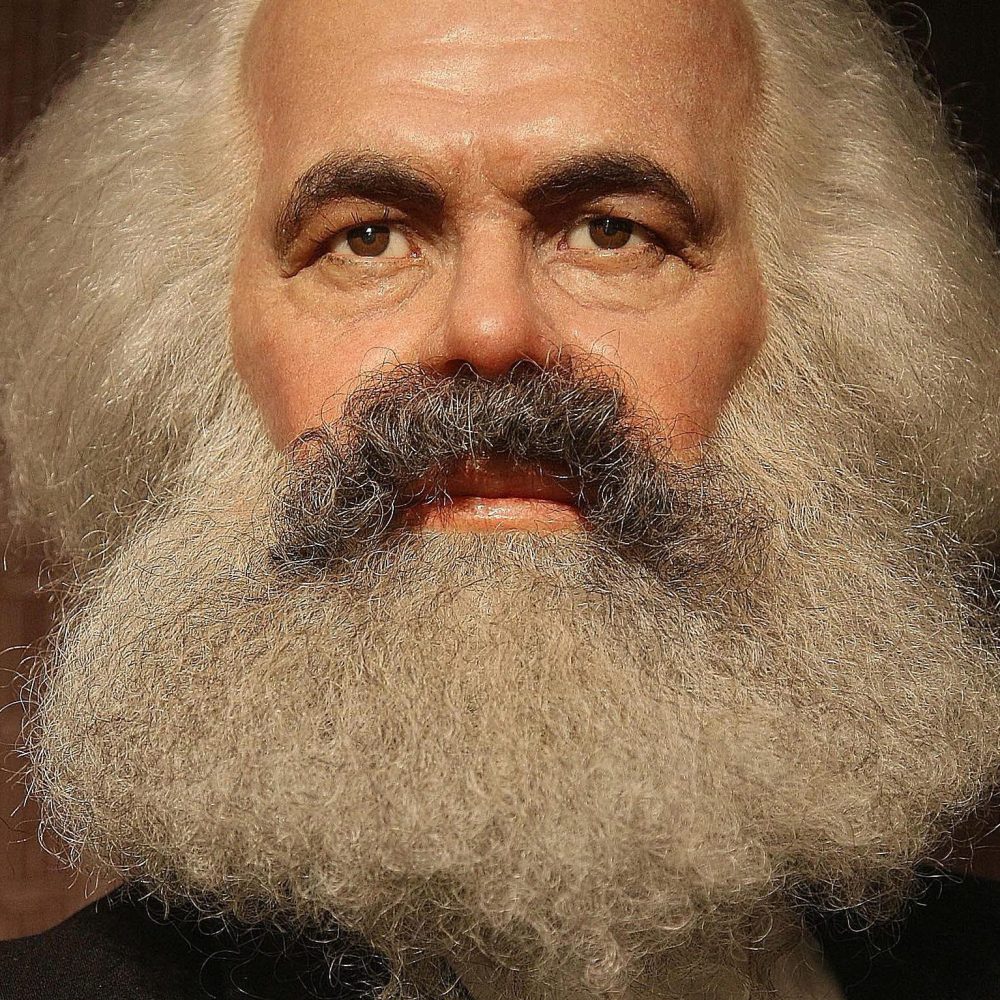
Karl, Marx and Fredrich Engels. 1848. “The Communist Manifesto – Parts I, II, IV” Pp. 245-262, 270-271 in Karl Marx: Selected Writings, edited by David McLellan, Oxford University Press.
- Notes based on version in 2nd Edition, published in 2000 (original in 1977)
Project: Proletarians will experience a shift in their position upon their own upheaval with a target of the bourgeoisie and an aim of a version of economic fairness, or even equality, but only after a society acknowledges their submission to the capitalist class.
OVERVIEW
Marx aims to outline the potential timeline of capitalism and its eventual downfall at the hands of a forming, communist economy. He and Fredrich Engels emphasize the importance of sharing views on communism, as it is unpopular to do so. Money relations have become the cornerstone of life and even kinship. Marx does not fail to offer the advantages presented to society by the concept of capitalism, from larger cities to the simplicity of urbanization. Antagonism must be reduced to zero and unionization must be at the forefront of all minds. Marx concludes with the necessary measures to produce accurate communism.
BULLETED NOTES
P. I – Bourgeois and Proletarians
- “Communism is already acknowledged by all European powers to be itself a Power” (246)
- Communists should publish their views
- We are becoming just two parties: bourgeoise and proletariat
- “…in proportion as industry, commerce, navigation, railways extended, in the same proportion, the bourgeoisie developed, increased its capital, and pushed into the background every class handed down from the Middle Ages” (247).
- While transportation and technology advanced collectively, capitalism was correlated and developing, reaching points nonexistent in height on the social hierarchy, causing lower classes to become invisible…
- Family relations reduced to money relation
- Interesting how between 248 and 249, almost every paragraph begins with “The bourgeoisie…”
- Positives this “elite” class has offered to society and our economy (according to Marx and Engels):
- Towns rule
- Increased size of cities
- Increased urban population (relative to rural)
- “…rescued a considerable part of the population from the idiocy of rural life” (249)
- Will no longer be a difference between the male and the female worker… “…all are instruments of labour…” (251)
- True success among workers is their union
- The bourgeoise is what supplements the working class with the tools they need to fight them. Sounds like they’re going in a circle.
- The lower middle class, small manufacturer, peasant, etc… fight the capitalists to remain as they are, which makes them conservative rather than revolutionary–because they want to stay put in their conditions instead of aiding in the transformation of their economy that is already happening.
- All previous movements have been carried out by and for minorities, but this one concerning proletarians includes the majority.
- The top makers are only producing their own grave-diggers!!!
P. II – Proletarians and Communists
- Interesting how the first section is on the relationship between bourgeoise and proletarians, and the second jumps to the proletarians and communists. This is an implicit prediction of who makes it through and who enters the picture.
- Reasons the communists are distinguished from other working-class parties:
- Give way to common interests of entire proletariat with no discrimination
- Represent the whole movement when working class is overthrowing bourgeoise
- Most advanced section of working-classes parties – Communist
- Their goal: “…formation of the proletariat into a class, overthrow of the bourgeois supremacy, conquest of political power by the proletariat” (256)
- Bourgeoisie: past dominates the present, capital is independent, living person is dependent, no individuality – “abolition of individuality and freedom” (257)
- Communist society: present dominates the past
- Private property is already nonexistent, so communism is not going to destroy it for you.
- Marx uses “you,” (257 bottom+) as if he is talking directly to the reader, which is… the German elites?
- “…there can no longer be any wage labour when there is no longer any capital” (258)
- Communism wants to rescue education from the influence of the ruling class…
- The Bourgeois has a system of wives in common, they share wives… openly legalized community of women
- “Uniformity in the mode of production” (260) – removes antagonism among people/classes, and after this — “Hostility of one nation to another will come to an end” (260)
- Through historical development, the following survived the changes: “religion, morality, philosophy, political science, and law…” (261)
- Prolestiriat must rise to ruling class in order for the battle of democracy to be won
- Communistic attributes/measures needed for revolution/what should/will happen first:
- No property/all public
- Progressive or graduated income tax
- No inheritance
- Take property from rebels and emigrants?
- Centralized credit (state)
- Centralized comm and transport (state)
- Instruments of production (state) used for environmental sustenance/soil
- Everyone works
- Agriculture and manufacturing join/no distinction between town and country/people more equally distributed across land
- Education free for all children combined with industrial production
P. IV – Position of the Communists in Relation to the Various Existing Opposition Parties
- Uses other countries to offer examples: France, Switzerland, Poland, Germany
- Proletariat do not see the antagonism between them and those above them
- “…Communists everywhere support every revolutionary movement against the existing social and political order of things” (271).
- “Working men of all countries, unite!” (271) (final words)
QUESTIONS
- What is barbarism? (250)
- “Society suddenly finds itself put back into a state of momentary barbarism; it appears as if a famine, a universal war of devastation, has cut off the supply of every means of subsistence;…”
- Collapse of civilization…
- Number four among the communistic measures named by Marx (262) is not clear to me: “Confiscation of the property from all emigrants and rebels”; who are the rebels? Are the emigrants those who leave or those who are coming from elsewhere for work?

 Perception