
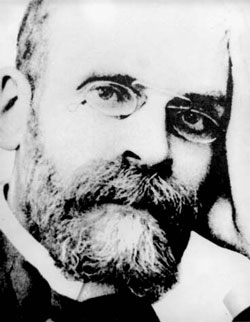
Durkheim, Emile. 1951 [1897]. Suicide, a Study in Sociology. [Preface; Introduction; & Pp. 207-220]. Glencoe, IL: Free Press.
Project: Durkheim aims to establish the certain ways in which society can influence a man’s pursuit of death by their own agency, which he attributes complexly but directly to social cohesion as a common denominating factor.
OVERVIEW
Durkheim outlines the implicit societal links to the act of suicide, in contrast to psychology, which assigns causation to the mind alone. Although this is important, society also plays a hefty role in that social forces constitute our being, enough to where we are dependent on a certain type of structure to remain upheld in our every-day lives. Suicide is only so when the actor is aware of the outcome, but not only this–is intending to reach the outcome of self-homicide, and when the act is carried out fatally. With forces, such as the economy and the need for cohesion, are disrupted, and the individual life of one is detrimentally impacted; one loses the social order they have had, leading to mental demise. One’s needs must be proportioned to what they have in order for order to remain in one’s life, enough to be fulfilling. Despite this, humans are always seeking more and generally fail to find satisfaction, seeking the unknown until they are known. Durkheim distinguishes between three types of suicide having to with society: Egoistic (due to the diminishment of social cohesion), Altruistic (due to an excess of social cohesion), and Anomic (due to a lack of social order (social regulation, economic health…)).
BULLETED NOTES
Preface
- “The progress of a science is proven by the progress toward solution of the problems it treats” (xxxiii)
- This statement is significant because it establishes the ultimate goal and purpose of scientific disciplines, including Sociology. It is a common question to ask of Sociology’s purpose, which is, thus to identify how to fix [the issues associated with the study].
- And suicide is a MAJOR problem… that needs fixing or at least some direction… so Durkheim’s goal is to get to the root of it.
- “Suicide as it exists today is precisely one of the forms through which the collective affection from which we suffer is transmitted” (xxxv)
- Collective affection? How does affection translate into the consequence of suicide?
- It is crucial to distinguish and draw the line between SOC and PSY, especially when it comes to the investigation of suicide… which is highly associated with psychology in terms of motivation…
- “But if no reality exists outside of individual consciousness, it wholly lacks any material of its own. In that case, the only possible subject of observation is the mental states of the individual, since nothing else exists. That, however, is the field of psychology” (xxxvi)
Intro
- A substantially critical point made by Durkheim has to do with how suicide can come about from positive and negative actions… as one can take their own life more violently, when positive (I say, since the victim is pursuing a physical means to it, typically) and possibly more gradually when negative… not just by starving themselves but maybe by isolating themselves from society for extended periods of time… this makes me wonder how else one could commit the act negatively… since positively, there is a world of possibilities…
- “Though suicide is commonly conceived as a positive, violent action involving some muscular energy, it may happen that a purely negative attitude or mere abstention will have the same consequence. Refusal to take food is as suicidal as self-destruction by a dagger or rearm” (xI)
- “…it is not easily observed. How discover the agent’s motive and whether he desired death itself when he formed his resolve, or had some other purpose? Intent is too intimate a thing to be more than approximately interpreted by another” (xIi)
- I understand the idea that it is difficult to determine cause in cases of possible suicide and difficult to rule whether a death is by suicide, but I might argue that it simply isn’t, at least not anymore. There have been sufficient advancements in the medical and forensic realms to almost precisely predict the cause of death in most situations, not to mention context clues, which are often adequate per se. Of course, one can observe patterns in the victim’s life decisions prior, as well.
- “Indeed, if the intention of self-destruction alone constituted suicide, the name suicide could not be given to facts which, despite apparent differences, are fundamentally identical with those always called suicide and which could not be otherwise described without discarding the term” (xIi)
- I wonder what else Durkheim is talking about in terms of what is confused with suicide, if not the act itself.
- “…the term suicide is applied to all cases of death resulting directly or indirectly from a positive or negative act of the victim himself, which he knows will produce this result” (xIii) – He must know that the result of suicide will be produced*
- “An attempt is an act thus defined but falling short of actual death. This definition excludes from our study everything related to the suicide of animals” (xIii)
- So, animals are incapable of suicide? Is what Durkheim is saying… because they cannot consciously decide to take their own lives… is this really true?
- I searched online a bit through various sources, and it looks like animals do and can take their own lives but not seemingly in the intentional way that humans do… they do in the form of sacrifice for their colonies (insects apparently) and otherwise do so inadvertently, the closest being accidental deaths due to grief, as they might refuse to eat due to depression… why can this not be deemed suicide? How can we really know? Is it because they did not INTEND it but it happened as a result of their careless, depressive actions? This would make sense. Might’ve answered my own question. But still, how do we KNOW that it’s not intentional? How do we know that these animals are not conceiving the outcome of suicide while they starve themselves or even sacrifice??
- Suicide rates only increased in every country given as an example in chart (xIvi) through time.
Anomic Suicide
- “Whenever serious readjustments take place in the social order, whether or not due to a sudden growth or to an unexpected catastrophe, men are more inclined to self-destruction. How is this possible? How can something considered generally to improve existence serve to detach men from it?” (207)
- Is there evidence of this? Suicide rates among men going up during such changes or is it just a general knowledge of that time period that they do at such times?
- I would say, if so, that it is so because men have traditionally had a heavier role in society and outside of the home where they endure the latent effects of such changes, and thus, are impacted physically, mentally, financially, and in other ways that can lead to grief, pity, and/or depression.
- “No living being can be happy or even exist unless his needs are sufficiently proportioned to his means. In other words, if his needs require more than can be granted, or even merely something of a different sort, they will be under continual friction and can only function painfully” (207)
- We must be getting as much as we need in order to be happy… anything short of this can have mentally destructive outcomes…
- *********************“What more can the future offer him than the past, since he can never reach a tenable condition nor even approach the glimpsed ideal? Thus, the more one has, the more one wants, since satisfactions received only stimulate instead of filling needs” (209)
- YES
- “…the man of wealth is reproved if he lives the life of a poor man, but also if he seeks the refinements of luxury overmuch” (210)
- “The workman is not in harmony with his social position if he is not convinced that he has his deserts. If he feels justified in occupying another, what he has would not satisfy him” (211)
- We must find satisfaction in what we do.
- “If inheritance were abolished, the argument runs, if everyone began life with equal resources and if the competitive struggle were fought out on a basis of perfect equality, no one could think its results unjust. Each would instinctively feel that things are as they should be” (211-212)
- Communism?
- “One sort of heredity will always exist, that of natural talent. Intelligence, taste, scientific, artistic, literary or industrial ability, courage and manual dexterity are gifts received by each of us at birth, as the heir to wealth receives his capital or as the nobleman formerly received his title and function. A moral discipline will therefore still be required to make those less favored by nature accept the lesser advantages which they owe to the chance of birth” (212)
- “Forcing us to constant self discipline, it prepares us to accept collective discipline with equanimity, while wealth, exalting the individual, may always arouse the spirit of rebellion which is the very source of immorality” (215)
- Durkheim claims here that our dire desire for money can cause us to act immorally! And that immorality is one result of our “greed” perhaps…
- “A thirst arises for novelties, unfamiliar pleasures, nameless sensations, all of which lose their savor once known” (217).
- We seek out the unfamiliar, in general, yeah! We want what we can’t have, as they say. But is this true of everyone? Probably not. There is this notion of the comfort zone, yeah? Which proves there are people who are fearful of the unfamiliar, and thus, remain in their positions. What about fear? I don’t think that this is applicable to everyone. I don’t think that EVERYONE wants what they don’t have or at LEAST, acts on their desires to have or experience what they haven’t.
- The three types of suicide (219):
- “Egoistic suicide results from man’s no longer finding a basis for existence in life…”
- Has kindred ties
- Society is not present enough in the person
- In collective activity, the person is detached from the society…
- Social cohesion is not there
- “…altruistic suicide, because this basis for existence appears to man situated beyond life itself”
- TOO MUCH social cohesion… personality has dissolved into the group…
- Not as common or likely now due to the rise of individuality…
- “The third sort of suicide…results from man’s activity’s lacking regulation and his consequent sufferings. By virtue of its origin we shall assign this last variety the name of anomic suicide”
- Has kindred ties
- Society is not present enough in the person
- “…society’s influence is lacking in the basically individual passions, thus leaving them without a check-rein” (219).
- Lack of rules and healthy economy… losing job, money, or some other drastic change… we reach a state of anomie and people are dissatisfied… those who suffer the most are those Durkheim says are leaning toward anomic suicide.
- Uncertainty about future…
- We struggle to find satisfaction in things… we always want more
- The limits of our desires are given to us by society
- When we have something, we sort of expect it to be there… ungrateful!?
- “Egoistic suicide results from man’s no longer finding a basis for existence in life…”
- Marriage, religion, work sector… (role in suicide)
- People lost their designated places in society, such as those which were set-in-stone in feudalistic times… integration became little to none and isolation became more common than not.
- In his work on DOL, Durkheim believes solidarity is possible in modern societies… not what he seemed to believe in this work?
- Too much cohesion is also bad! So, one must reach an optimum level of cohesion, not the maximum…
QUESTIONS
- “Suicide as it exists today is precisely one of the forms through which the collective affection from which we suffer is transmitted” (xxxv)
- Collective affection? How does affection translate into the consequence of suicide?
- Can animals taking their own life BE considered suicide, ever (xIii)? (elaboration on this under Intro notes)
- Why do more men commit suicide during times of drastic change or unexpected events in social order (I sort of answered myself above) (207)?
- (217) We want what we don’t have unil we have it, but is this applicable to the whole of people? I think we might vary in this respect, and thus, this notion would be turned over to our friend, psychology since we become incapable of generalizing here.

 Perception