
What do you know? Or rather, what do you think you know? Do you know anything? What information are you accepting as true and sharing as fact?
Information has various categories which can be distinguished by their origins. The origins of information can be from either creation or discovery. Information comes from creation when it is masterfully crafted at the hands of human beings or an entity created by human beings to be capable of creation. Information is discovered when it is found and presented utterly undisturbed and in its natural and original form and setting.
Now, how is the difference told? It is not, and it cannot be because, in 2024, essentially nothing has been left undisturbed, untampered with, or undistorted in order to serve agendas and motives of the presenters of the information. Therefore, nothing is known or can be known, and to claim knowledge, again, is a mere demonstration of ignorance and arrogance, happening to be among the most common traits of the human being, who is at the source of misinformation and disinformation and at the source of sharing distortions and confusions related to the inability of information recipients to distinguish between created information and discovered information.

A quality of human beings which has been consistently shown throughout history and that has not only remained intact but worsened, is that of greed, but also arrogance, ignorance, and the innate, as well as learned, desire to dictate, and desire for ownership.
At this point in time, there is ultimately no hope for human beings to return to or find their humbly intuitive state, that which enables acceptance, love, appreciation, voluntary service, care, and the sharing of goods, the commons, and wisdom, and most importantly, at no cost and for no monetary or materialistic return or benefit. One could live in such a state only at the verily sacrificial cost of their existence, let alone their comfort or survival, due to the current human landscape.

Far and few in between are those remaining on earth with characteristics that may mimic this state; however, a depletion and torturous degradation of it (the ability to embody the state and/or its defining behaviors) is inevitable and so speedy and effective that not a being will be left now before their ending to feel their authentic connection to the universe, nor to share their now-lost primal abilities to live and experience the life a human being is [supposed to be] capable of.
This is, at best but not only, in reference to monumental advancements in computational gadgetry that enable both artificial intelligence and the resulting convenience to the human mind, and this convenience is only an anchor on the capacity of the human being, transforming it from an intuitively capable creature of mindful thought and curiosity to a superficially dependent existence of attention-deficient flesh now capable of only thoughtlessness and obedience.

Notwithstanding, all that is shared is done so through an ulteriorly motivated source whose primary source could never be traced, leaving all shared information to be erroneous, and secondary at the least. Everything that is thought or considered to be learned comes from, or happened in, the past but is being shared and digested in the present. When today is the day information is being learned, but yesterday was when the information was born, where can assurance that tampering of documentation or errors in shared spoken word could not have occurred?
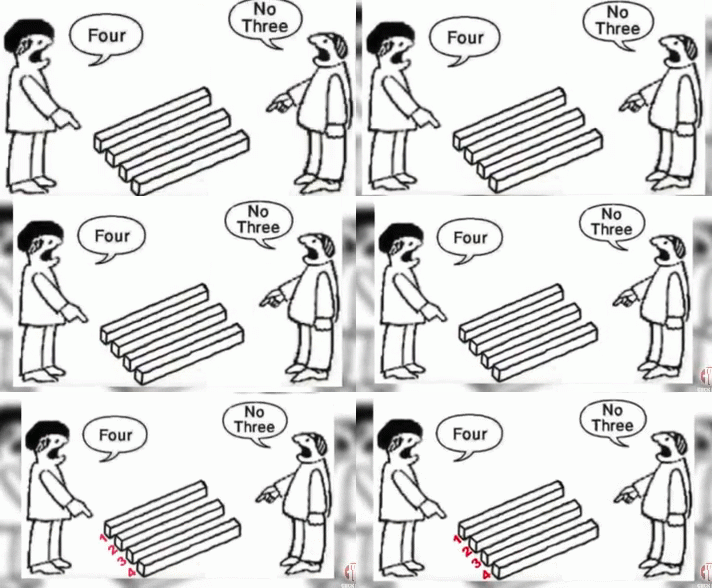
Ultimately, the optimal method of obtaining knowledge, or of information exposure, is through empirical observation and study. The capacity of the human to experience the world vis-a-vis the five senses and in present time allows the experiencer to witness information and what exists in real time, and this experience cannot be falsified or tampered with but until its relay to others. This first-hand experience—which yields descriptive results and is an example of discovered information—is valid because the results are produced with accuracy by the experience of human senses, but the results cannot be deemed reliable because the perception of one observer can be different from another.

Observers are naturally partisan, or biased, and cannot seamlessly and unwittingly embody impartiality and neutrality in their experience and consumption of the world, especially not without a conscious effort to attune to the senses alone with a complete disregard for the subconscious, personalized, and socialized cognitive filtration systems ruling perception.
All that is perceived by the human must first seep through the maze that is the observer’s own cognitive filtration system—which develops from preconceived notions—in order to simultaneously contaminate, or perhaps cleanse, a pure idea or matter form to best harmonize with those rusty notions and wishful hopes that a person holds onto. The system alone tampers with information in a way that allows it to be understood by the observer, so the process is bound to differ across a population of experientially and socially diverse people. Since empirical study relies on sensory experience, experiences of information and what exists are in accordance with and strictly reserved to the terms and conditions of the unique observer.
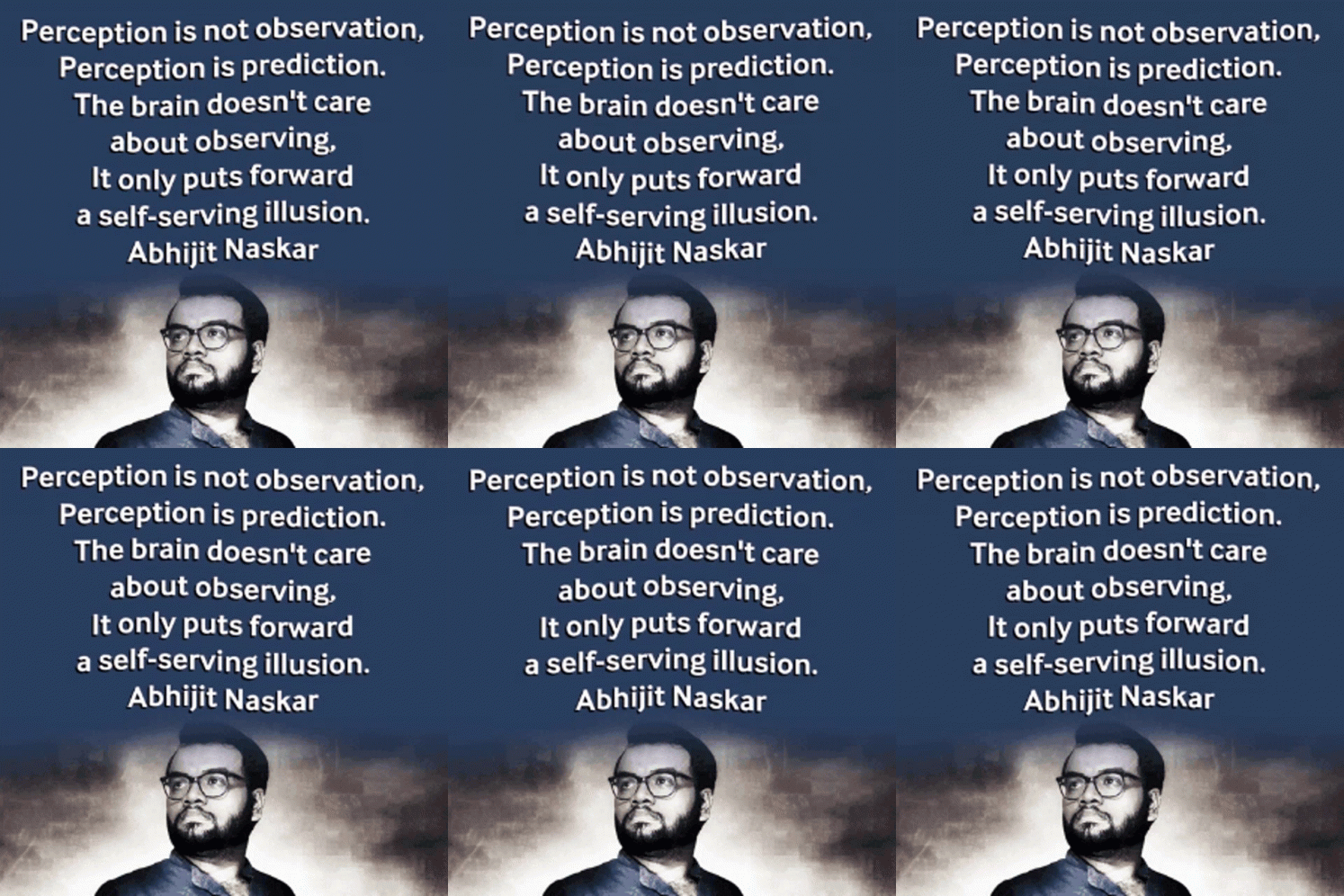
Hence, perception, which can be flawed and faulty, is the sole method of information acquisition, which makes information acquired through empirical observation non-representative of all experiences, or even the purest, truest form of the said experience, meaning it is practically impossible to share knowledge that is experienced the same way by every being, and to possess knowledge that is absolute. Therefore, it is abundantly challenging to determine whether any information exists with accuracy and purity.
Practically nothing before this very moment can be confirmed, and much like the infamous game of telephone, information from the past becomes increasingly difficult to decipher over time due to its checkpointed path, but unlike the game of telephone, the information cannot be confirmed with the original source in present time because they are not sitting at the end of the table before our very eyes but rather buried beneath infinite layers of time, falsehoods, and motivated deception that cannot be dug through or travelled to, meaning the origins of information are inaccessible.
Thus, is our understanding of all we know about the world potentially most accurately described as telephoned? And if this appears to be the case, what do you know? Or rather, what do you think you know? Do you know anything?
*Please note this piece appears inherently negative in terms of perspective on human civilization and evolution but is intended solely to inspire critical thinking and certainly not to discredit knowledge or its possession or to condemn either learning or teaching (which are considered fundamental to the experience of a human being!).

 Perception